
These six people have created a political climate more difficult for business, indeed more hostile to business, than at any time since the mid-1980s.
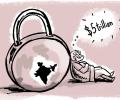
India will need $8 trillion (around Rs 588 lakh crore) of gross capital formation or new greenfield assets to become a $5 trillion (around Rs 368 lakh crore) economy by FY2027, a report said. The report by Deloitte said despite the COVID-19 disruption, FDI inflow into the country provides necessary optimism and display underlying strengths of the Indian economy. In FY2020-21, FDI inflows (including equity, re-invested earnings, and capital) amounted to a record $81.72 billion, 10 per cent higher than the previous financial year, it said.
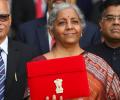
Had Finance Minister Sitharaman thought a little more about the middle class, disadvantaged sections, and the poor who are struggling, it would have been an inclusive Budget that would have made history, notes Ramesh Menon.

Contract workers are paid much less than regular workers. This year's Economic Survey estimates wages are on an average 20 times higher in the formal sector than in the informal sector. Arindam Majumder reports.

The standard line that is used for anyone -- academics, minorities, farmers, dissident industrialists -- who points out that what the government is doing is wrong is being anti-national and separatists, reveals Aakar Patel.

'With the ease of access, we have seen an increased participation from tier-2, tier-3, and tier-4 cities/towns.'

India remains a young nation, but it will not get younger in future. India has not managed to noticeably improve education. Nor has it managed to create employment opportunities, observes Devangshu Datta.

The most common abuse happens in marriages in the confines of one's own home. Be it raising a hand on one's spouse without the slightest provocation, or abusing them without their consent, notes Aarti David.
India's manufacturing sector activities improved in September as companies benefited from strengthening demand conditions amid the easing of COVID-19 restrictions, a monthly survey said on Friday. The seasonally adjusted IHS Markit India Manufacturing Purchasing Managers' Index (PMI) improved from 52.3 in August to 53.7 in September, indicating a stronger expansion in overall business conditions across the sector. The September PMI data pointed to an improvement in overall operating conditions for the third straight month. In PMI parlance, a print above 50 means expansion while a score below 50 denotes contraction.

'An area of land has already been earmarked for their protected habitation.' 'There are also steps being taken to take care of the coral zone and mangroves.'

The competition for the worst or most perilous 10 years has always been between the 1960s and the 1980s, points out Shekhar Gupta.

The transmogrification of Prime Minister Modi to Saint Modi began with the ground-breaking ceremony of the Ram temple in Ayodhya. By identifying himself with Lord Ram, Modi raised himself in popular imagination to a saintly person.
Oil explorer ONGC again emerged as the highest profit-making PSU of the country during 2012-13 while telecom major BSNL turned out to be the biggest loss-making enterprise, says the Economic Survey.
According to the Regus business confidence survey, Indian businesses' confidence index decreased 2 points (from 143 to 141) since April 2012.

The national per capita income in 2013-14 stood at Rs 87,748.

As part of the ritual, ''halwa'' is prepared in a big ''kadhai'' (large frying pot) and served to the entire staff involved in the Budget making exercise of the ministry. Halwa was served while maintaining COVID protocol with all present in mask and those distributing sweets were wearing gloves.

The Bharatiya Janata Party is ahead in 20 seats in Manipur, with Chief Minister N Biren Singh leading by a handsome margin of more than 16,000 votes against his nearest Congress rival in Heingang constituency, Election Commission data showed.

Services sector activities improved further and touched a five-month high in April driven by a surge in incoming new work orders that boosted business activity and supported a renewed increase in employment, according to a survey. The seasonally adjusted S&P Global India Services PMI Business Activity Index jumped to 57.9 in April, from 53.6 in March, highlighting a sharp rate of expansion that was the fastest since last November amid mounting price pressures. For the ninth straight month, the services sector witnessed an expansion in output.

India will either have to create a system in which certain geographical areas will wind up being permanent political outsiders at the Union level or it will have to create a system in which certain votes are weighted more heavily than others, observes Mihir S Sharma.

The HSBC India Manufacturing Purchasing Managers' Index for the manufacturing industry climbed from 49.6 in October to 51.3 in November on the back of a rebound in new orders and output.

Indian Railways has to up investment to strengthen network just like China and Russia.

A majority of the CEOs are expecting the economy to show growth in the next financial year on the back of rising consumer spending and a sharp turnaround in rural India.
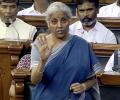
India is facing no risk of recession or stagflation as macroeconomic fundamentals of the economy are strong, Finance Minister Nirmala Sitharaman said on Monday. Replying to a debate on price rise in the Lok Sabha, she said the GST collection and Purchasing Managers' Index (PMI) are indicating that the Indian economy is getting more robust. The GST collection rose 28 per cent to touch the second-highest level of Rs 1.49 lakh crore in July. GST, introduced in July 2017, touched a record high of Rs 1.68 lakh crore in April 2022.

The economy could grow at 6-6.5 per cent this fiscal year (2019-20 or FY20), said Chief Economic Advisor Krishnamurthy Subramanian, revising his earlier estimate of 7 per cent in the Economic Survey. In an interaction with Arup Roychoudhury, he said supply-side measures, including corporation tax cuts, will boost consumption and demand, and non-tax revenue may make up for shortfall in tax revenues.
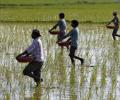
Telangana's Rythu Bandhu policy is an embryonic UBI, or rather embryonic QUBI (a quasi-universal basic income, pronounced Kyoo-Bee). And it could potentially also be the future of agricultural policy in India, says Arvind Subramanian.
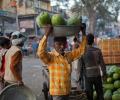
The country has been clocking a sub-5 per cent growth for the past two financial years, mainly on account of slowdown in investments.
The IHS Markit India Services Business Activity Index improved from 52.7 in November to 53.3 in December, highlighting the second-strongest rate of increase in output in over a year, after July. However, the overall level of positive sentiment remained below its long-run average.

Total employment generated by nine select sectors stood at 3.10 crore in the July-September 2021 quarter, which is 2 lakh more than that of the April-June period, according to a quarterly employment survey by the labour ministry released on Monday. The quarterly employment survey (QES) report released by Union Labour Minister Bhupender Yadav said that total employment numbers in the nine select sectors were 3.08 crore in April-June 2021.

Events to keep an eye out for...

Sri Lanka's Hambantota Port authorities said the high-tech Chinese research vessel that was to dock there on Thursday won't reach the port as scheduled, according to a media report, days after India expressed security concerns over its presence in the island nation.
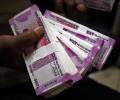
Without accounting for refunds, however, the collection contracted 5.4 per cent, indicating muted economic activity as the Covid-19 pandemic and subsequent curbs paralysed most sectors.

The 'bad bank' -- which will help banks clear their balance sheets by transferring the NPAs to special purpose vehicles -- has been one of the most debated ideas for stressed asset resolution.

The Indian Premier League (IPL) 2015 made a contribution of Rs 11.5 billion (USD 182 million) to India's GDP, a survey conducted by top financial auditing firm KPMG on behalf of the BCCI has said.

Finding is part of a survey conducted by Janaagraha Centre for citizenship and democracy

India's gold demand increased by 19.2 per cent to 76.1 tonne during the April-June quarter this year, largely due to low base effect, owing to the nationwide lockdown that hit economic activity last year, the World Gold Council (WGC) said in a report. The overall gold demand during the second quarter of 2020 calendar year stood at 63.8 tonnes, according to the WGC's 'Gold Demand Trends Q2 2021' report. In value terms, India's gold demand witnessed 23 per cent growth during April-June quarter at Rs 32,810 crore, compared to Rs 26,600 crore during the corresponding period of 2020.

Religion matters. Aspirational India is still poor. India admires strong leaders. India values decency. Shreekant Sambrani highlights the reasons why the BJP pulled off improbable victories in the Hindi heartland.

'It is inconceivable that there are no gays working in Indian corporations but obviously, the subject remains taboo enough in the workplace for those of alternate sexual orientation to feel safer remaining in the closet,' notes Kanika Datta.

China's population in 2022 -- 1.4118 billion -- fell by 850,000 from 2021, the National Bureau of Statistics (NBS) said.
 © 2026 Rediff.com - Advertise with us - Disclaimer - Privacy Policy - Sitemap - Feedback - About us - Terms of use - Grievances